Fake It Till They Write Your Name on the Electrical Panel
Fake It Till They Write Your Name on the Electrical Panel Confidence is a Skill.
I Learned This on the Romanian Border. How I Became a Military Legend Without Actually Being Dangerous
Around 1990 or '91 — I can't be entirely precise, record-keeping wasn't my strong suit back then — the authorities had developed a somewhat personal interest in my activities. Nothing dramatic. Just a long and colourful series of minor incidents that had apparently accumulated into something they felt required a response.
I decided the sensible move was to make myself scarce for a while.
Now, in the circles I moved in, our understanding of how the legitimate world operated was largely mythological. We knew it existed — out there somewhere, beyond the underpasses and the train stations — but the details were fuzzy. What we did have was a rich oral tradition of urban legends, passed around with great conviction and absolutely no verification.
One of these legends held that if you enlisted in the army, any legal unpleasantness waiting for you on the outside would simply cease to exist. Wiped clean. Fresh start.
As it turned out, this was only true of the French Foreign Legion. And I have my doubts about that too.
Nevertheless — when the next conscription notice arrived, unlike its predecessors which had met various creative ends involving fire, imaginative postal redirection, and on one occasion a drain — I did not destroy it. I reported for duty.
Cheerfully, even. Though in this context, "cheerfully" meant something closer to a smile that started somewhere near the stomach and never quite made it to the face.
The Strategy
The army, as everyone knew, had its own mythology. Specifically: that it was designed to make your life as unpleasant as possible, through methods both inventive and tedious. I had heard the stories. I had mentally prepared.
What I had going for me was this: I had read extensively as a child. Everything I could get my hands on — and that included, somewhere along the way, a few texts on psychology, persuasion, and the mechanics of how people establish dominance.
The physical side of things was less promising. I was 164 centimetres tall and approximately 55 kilograms. This was not a presence that made rooms go quiet.
So I went with the next best thing: absolute, unwavering, slightly unhinged confidence. Full commitment. No hesitation. No visible awareness that my size might be considered relevant information.
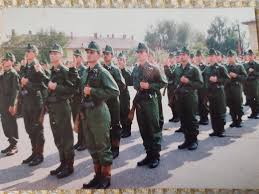
The sergeants at the Orosháza barracks were, I am pleased to report, not prepared for this. They pulled their hair. They raised their voices in ways that suggested genuine personal distress. One of them, I think, started reconsidering his career.
I considered this an excellent start.
Battonya
From basic training I was posted to Battonya — a small village sitting directly on the Hungarian-Romanian border, the kind of place where the wind arrives from the east already annoyed about something and doesn't improve.
My reputation had arrived before I did. This was both gratifying and mildly amusing, because when I actually showed up — somewhat dishevelled, marginally intoxicated, and conspicuously un-imposing in every physical dimension — there were several visible moments of recalibration among the welcoming committee.
I maintained the persona anyway. It was working, and I saw no reason to introduce new information.
A few weeks in, a colleague pointed out something on the electrical panel in the corridor. Someone — and I have never confirmed a suspect — had taken a thick black marker, crossed out the standard warning text on the 380-volt distribution board, and replaced it with:
"Caution: B. Eugene — Danger to Life"
This had achieved unanimous approval from both the enlisted men and the officers. Which was notable, because on most other topics, these two groups agreed on very little.
I should explain that I had a certain relaxed approach to military hierarchy. Ranks, titles, the careful choreography of who salutes whom and in what order — I found all of this mildly optional. I spoke to generals the same way I spoke to everyone else, which is to say: directly, without particular ceremony, and about whatever seemed relevant at the time.
This resulted in several visits to the detention cell.
It didn't bother me much. I had nowhere else to be.
The Week Off
Eventually — presumably as an experiment, or possibly out of exhaustion — they let me out for a week's leave.
I did what any reasonable person would do: I toured the rock bars and concert venues of rural Hungary. In military uniform, which turned out to be an excellent financial strategy — people tend to buy drinks for soldiers out of a mixture of patriotism, respect, and mild uncertainty about what might happen if they didn't.
Several days passed in this manner. Then several more. Winter deepened. At some point I sold my coat — concert ticket and drinks, a transaction that seemed entirely reasonable in the moment and only slightly less reasonable in retrospect.
Eventually I lost track of what day it was. And I don't mean this casually. I mean I genuinely did not know what day, or possibly what week, it was. The timeline had become a suggestion rather than a fact.
When I finally climbed back through a window, slept for what felt like a geological epoch, and returned to the barracks — I was, against all personal precedent and historical probability, one day early.
This was so far outside my normal operating parameters that it briefly confused even me. The standard pattern involved arriving two days late, visibly weathered, while search parties were already being coordinated across multiple counties.
I chose not to examine this too closely. Some anomalies are best left unexplained.
Six Months Later
By the time the year was drawing to a close, the performance had long since become unnecessary. The reputation had calcified into something entirely self-sustaining. Nobody wanted to test it. I didn't push my luck — my physical dimensions had not changed, after all, and there's only so much psychology can do against basic arithmetic.
Two of my oldest friends come from this period. We understood each other immediately and completely, in the way that people do when they share a certain outlook on rules, authority, and the fundamental absurdity of systems that take themselves very seriously.
And there is one image from those nights that has stayed with me.
Two in the morning. Out on the border. Another teenage conscript beside me, a dog that seemed equally uncertain about the career path it had chosen, and a night-vision scope showing approximately fifty people moving toward us through the darkness. Quietly. With clear intent.
That required a somewhat different kind of composure than the usual performance.
The blood pressure, I can confirm, was significantly elevated.
But the presence held. Obviously.
The lesson, if there is one: confidence is a skill. Reputation is a system. And sometimes the most useful thing you can bring to a situation is the complete refusal to acknowledge that you might be at a disadvantage.
This turns out to be just as true in online marketing as it is on the Romanian border at two in the morning.
More on that later.
— Eugene B.
