
Why I Stopped Asking "Does It Work?" and Started Asking "Does It Pay?"
Why I Chose Affiliate Marketing Over Everything Else (Or: how an engineer thinks about online business — and why that's actually useful.)
There's a piece of conventional wisdom in the online business world that goes something like this: the hardest part is making your first dollar. Once you've done that, you just repeat the process, scale it up, and watch the numbers grow.
I have heard this many times.
I have also, at various points, made money from methods that were definitely not affiliate marketing.
And I'm here to tell you that making your first dollar is not, in fact, the hard part. The hard part is making a dollar that costs less than a dollar to make.
This distinction turns out to be quite important.
The Engineer's Problem
I should explain something about how I think.
I spent years as an engineer. Before that, I studied to become one while working full time and raising children, which required a certain systematic approach to problems — because if you don't think clearly about what you're doing and why, you run out of time, money, and patience very quickly, usually in that order.
This habit of thinking in systems did not switch off when I started researching online income.
So when I tested various methods during those eighteen months — and yes, some of them produced results — I found myself doing something that apparently not everyone does automatically:
I looked at what it cost to produce those results.
Results Are Not the Same as Profit
Here's what I found.
Some methods worked, in the narrow sense that money came in. Ads ran, clicks happened, sales occurred. The first dollar arrived, and then more dollars after it.
The problem was the mathematics.
When I sat down and calculated the actual cost of acquiring those results — the ad spend, the tools, the courses, the time — the numbers told a story that the headline figures did not. In several cases, I was spending more to generate the income than the income was worth.
This is what engineers call an unfavourable input-output ratio. What everyone else calls losing money while feeling busy.
Scaling, I reasoned, was not the answer. There is very little logic in running faster in the wrong direction. If a method is producing losses at small scale, increasing the volume does not improve the situation — it accelerates it. I had no particular interest in reaching my financial destruction more efficiently.
So I kept looking.
What Affiliate Marketing Actually Solves
When I finally understood the affiliate marketing model properly — not the hype version, but the actual structural logic of it — what struck me was not the income potential. It was the cost structure.
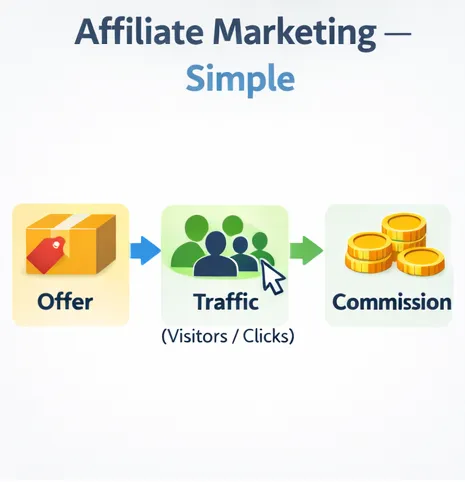
Someone else builds the product. Someone else handles the infrastructure, the customer service, the payment processing, the delivery, the complaints, the returns. Someone else has already done the expensive, time-consuming work of creating something people will actually pay for.
Your job is the introduction. Find the people who have the problem. Show them the solution. If they buy, you earn a commission.
The entry costs are manageable. The tools needed to start are minimal. There is no inventory to fund, no customer to disappoint at 11pm, no logistics chain to untangle.
More importantly: the ratio between input and output is one you can actually calculate before you commit. And then improve over time, methodically, as you learn what works.
For someone with a full-time job, a family, a house being extended one hour at a time, and a deeply ingrained habit of asking "but does the maths actually work" — this was not a small thing.
The Honest Version
I want to be clear about something.
Affiliate marketing is not free money. It is not passive in the way the word is usually deployed — implying that once set up, it runs itself while you sleep. That version exists eventually, maybe, for some people, after a significant amount of non-passive work has been done first.
What it is, for a beginner with limited capital and limited time, is the model with the most favourable risk profile. The one where you can test without betting the house. The one where the losses, when they happen, are recoverable. The one where the system makes sense before you commit to it — not just after.
That was enough for me.
I didn't choose affiliate marketing because it was exciting. I chose it because when I drew it out on paper and ran the numbers, it was the one that didn't require me to be either wealthy or reckless to get started.
For an ex-welder from Budapest with a mortgage and two kids in school, that mattered.
The lesson: making money online is not the goal. Making money online profitably is the goal. These are not the same thing, and the difference between them is worth understanding before you spend eighteen months and several thousand dollars finding out the hard way.
Ask me how I know.
— Eugene B.
